Executive Summary: Quick Takeaways
For Security Leaders & Executives:
- The Threat: Pro-Russia hacktivist groups (CARR, NoName057(16), Z-Pentest, Sector16) are actively compromising U.S. critical infrastructure using basic attack methods—scanning for exposed VNC connections and exploiting weak passwords.
- Sectors at Risk: Water/Wastewater, Food/Agriculture, and Energy facilities have been successfully attacked, causing operational disruptions, equipment damage, and significant remediation costs.
- The Paradox: Organizations focus on sophisticated threats while basic vulnerabilities remain unaddressed. Traditional CVSS severity scoring fails to capture the true business risk of OT vulnerabilities.
- The Solution: Quantified Vulnerability Management (QVM) translates security weaknesses into financial exposure, enabling risk-based prioritization that reflects actual business impact rather than abstract severity scores.
- Action Required: Inventory internet-facing OT assets, quantify financial risk exposure, implement CISA's recommended mitigations based on ROI, and establish continuous risk monitoring.
- Bottom Line: The most dangerous vulnerabilities aren't always the highest CVSS scores—they're the ones with the highest quantified business impact in your specific operational context.
Source: CISA Advisory AA25-343A
Featured Insight: Basic Vulnerabilities Driving Real Impact
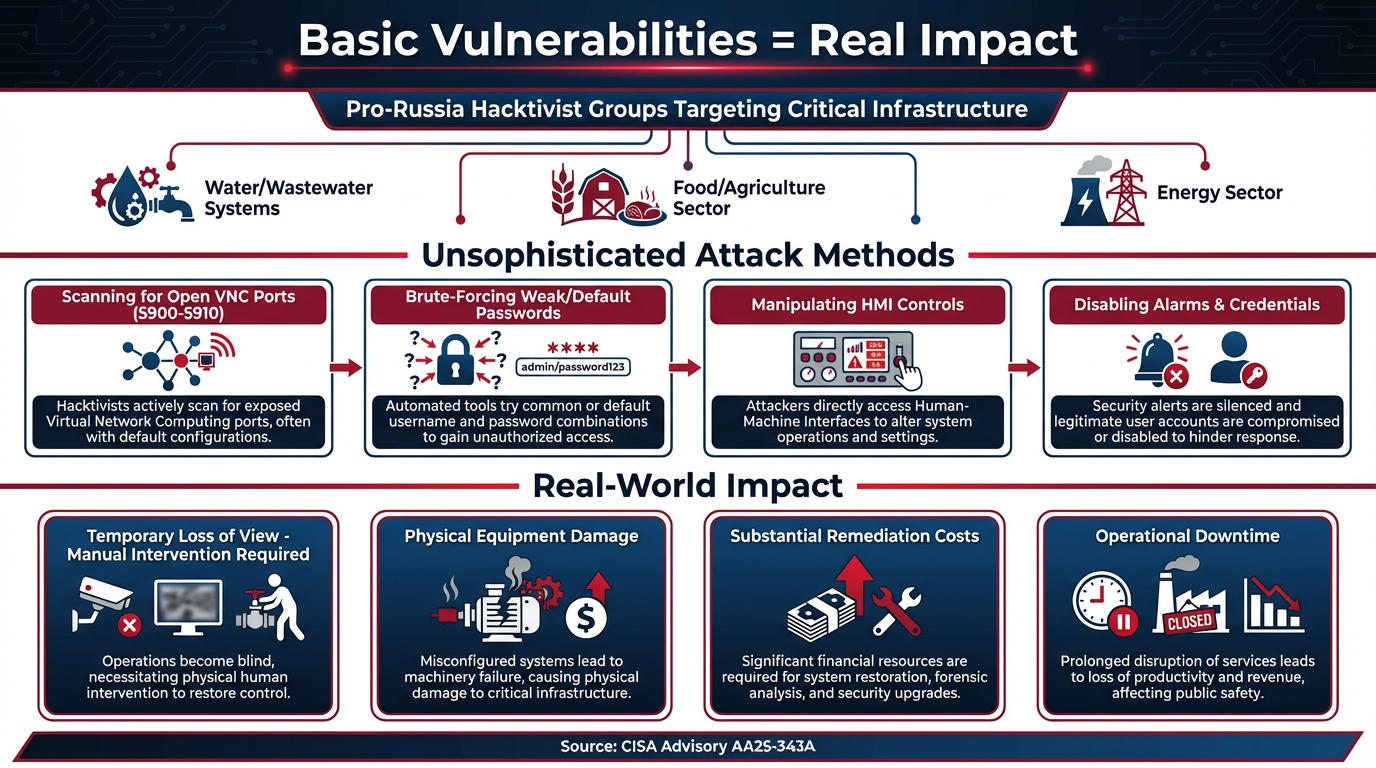
Source: CISA Advisory AA25-343A
A newly released joint cybersecurity advisory from CISA, FBI, NSA, and international partners reveals a sobering reality: pro-Russia hacktivist groups are successfully compromising critical infrastructure using some of the most basic attack methods imaginable. The advisory (AA25-343A) details how groups like Cyber Army of Russia Reborn (CARR), NoName057(16), Z-Pentest, and Sector16 are exploiting elementary security weaknesses in operational technology (OT) environments—and the implications for vulnerability management are profound.
The Unsophisticated Attacks Causing Real Damage
What makes this advisory particularly concerning isn't the sophistication of the attacks—it's the lack thereof. According to CISA, these hacktivist groups are compromising water treatment facilities, food and agriculture operations, and energy infrastructure using tactics that cybersecurity professionals would consider rudimentary:
- Scanning for open VNC ports (typically 5900-5910) on public-facing internet connections
- Brute-forcing weak or default passwords on Human-Machine Interface (HMI) devices
- Manipulating control parameters through graphical user interfaces with minimal technical knowledge
- Disabling alarms and changing credentials to create operational disruptions
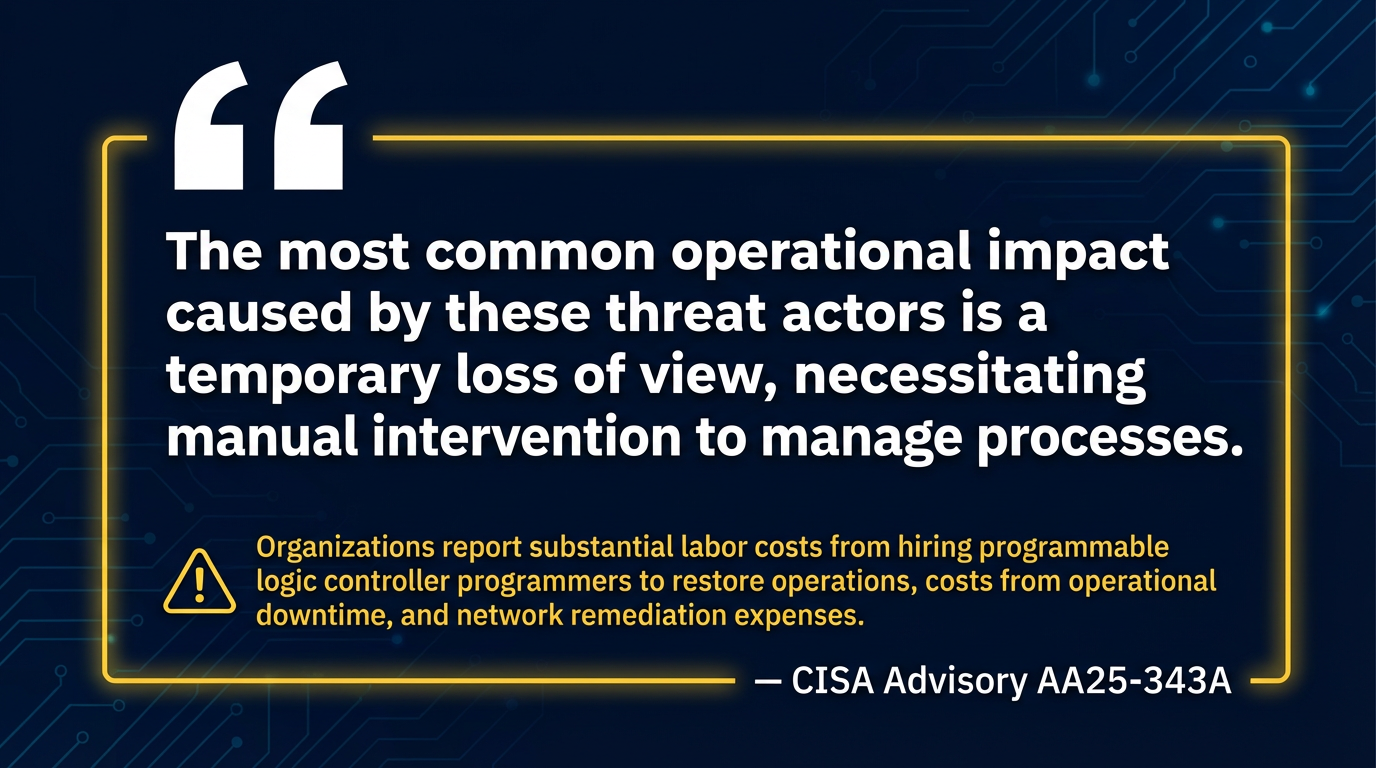
Despite their limited technical capabilities, these groups have caused tangible impact: temporary loss of operational visibility, physical parameter changes, equipment damage, and significant remediation costs. As the advisory notes, victim organizations reported that the most common impact is "loss of view," forcing operators to switch to manual controls while spending resources to restore compromised systems.
The Vulnerability Management Paradox in OT Environments
This situation highlights a critical paradox in operational technology security: organizations are often focused on advanced persistent threats while basic hygiene vulnerabilities remain unaddressed.
The CISA advisory identifies several fundamental security weaknesses that enabled these attacks:
- Internet-exposed OT assets with minimal access controls
- Default or weak authentication credentials on critical control systems
- Lack of network segmentation between IT and OT environments
- Insufficient asset inventory and visibility into OT attack surfaces
- Missing authentication requirements for HMI device access
For security teams managing thousands of vulnerabilities across IT and OT environments, the challenge becomes: How do you ensure these "basic" vulnerabilities receive appropriate priority when they compete with high-CVSS score software flaws?
Impact Spotlight
Why Traditional Vulnerability Scoring Fails for OT Security
The incidents described in the CISA advisory expose a fundamental limitation of conventional vulnerability management approaches. Traditional CVSS scoring—designed primarily for IT environments—often fails to capture the true risk of OT vulnerabilities for several reasons:
Context blindness: A weak password on an internet-facing HMI controlling water treatment processes poses exponentially greater risk than the same weakness on an isolated development server. CVSS scores don't reflect this operational context.
Asset criticality gaps: The advisory describes attacks on occupied facilities and community infrastructure. The business and safety impact of compromising these assets far exceeds what a generic severity score can convey.
Exploitability vs. exploitation: While advanced zero-day exploits receive high CVSS scores, the advisory demonstrates that actively exploited basic weaknesses (default credentials, exposed VNC) may warrant higher prioritization despite lower technical severity.
Cascading operational impact: When threat actors disable alarms, modify control parameters, or create loss of view, the downstream effects—operational downtime, manual intervention requirements, programmer costs, potential safety incidents—represent quantifiable business risk that vulnerability scores don't capture.
Rethinking Vulnerability Prioritization
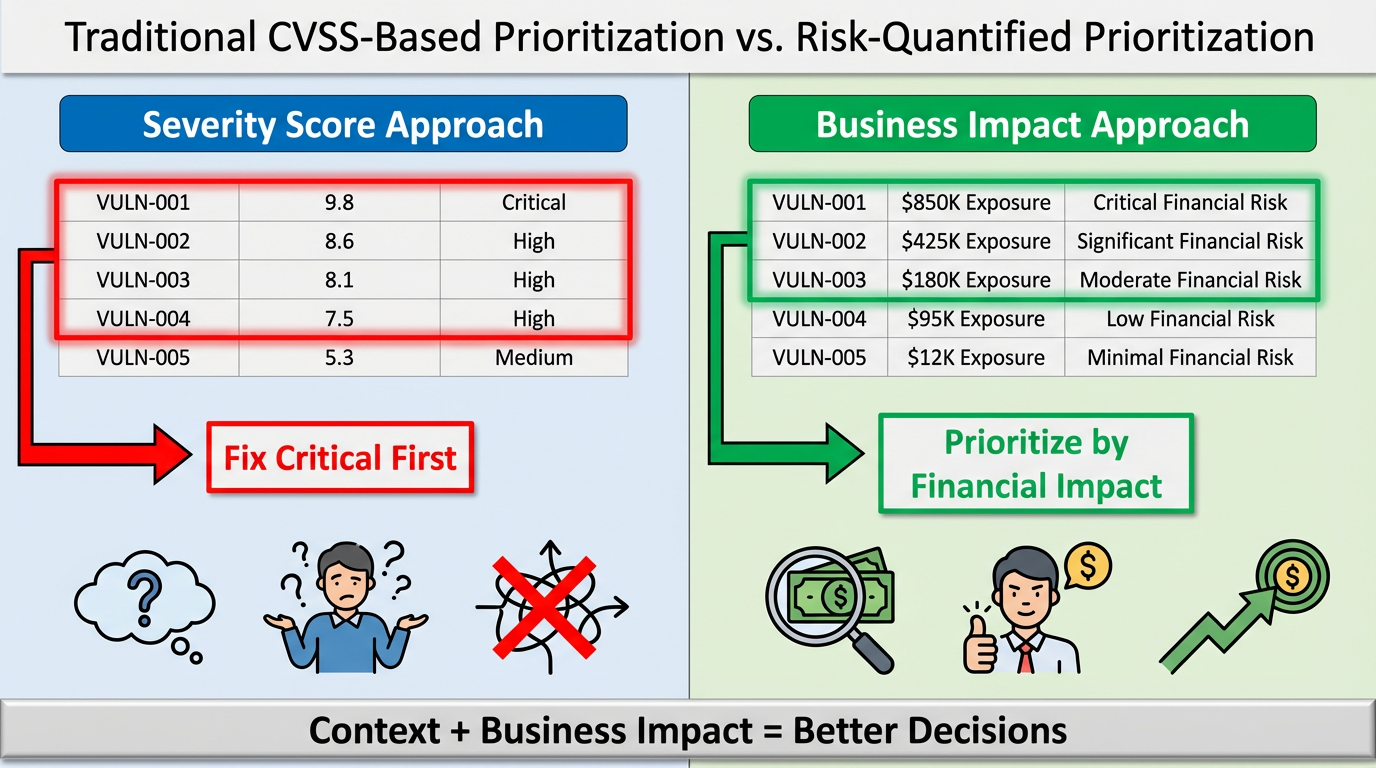
Traditional severity scores vs. business-impact prioritization
The Case for Quantified Vulnerability Management in OT
The CISA advisory implicitly makes the case for a fundamental shift in how organizations approach vulnerability management for operational technology: moving from severity-based prioritization to risk-quantified decision-making.
Quantified Vulnerability Management (QVM) addresses the OT security challenges highlighted in the advisory by enabling organizations to:
- Quantify Business Impact in Financial Terms
Rather than treating all "critical" vulnerabilities equally, QVM translates security weaknesses into quantified financial exposure. For example:
- What is the dollar value of operational downtime if threat actors compromise an HMI and force manual operations?
- What are the remediation costs if attackers change PLC configurations?
- What regulatory penalties or liability exposure exists if safety systems are disabled?
Solutions like DeNexus' Quantified Vulnerability Management (QVM) help security teams model these scenarios, enabling risk-based prioritization that reflects actual business consequences rather than abstract severity scores.
- Contextualize Vulnerabilities Within OT Operations
The advisory emphasizes the importance of "mature asset management processes, including mapping data flows and access points." DeRISK QVM extends this concept by mapping vulnerabilities to specific operational contexts:
- Which assets are internet-facing versus air-gapped?
- What processes would be disrupted if an asset is compromised?
- How quickly can operations switch to manual controls?
- What redundancy and failover capabilities exist?
This contextual awareness ensures that a weak password on a public-facing SCADA system receives appropriate priority over a higher-CVSS vulnerability on an isolated engineering workstation.
- Enable Data-Driven Remediation Investment Decisions
CISA's mitigation recommendations—implementing network segmentation, upgrading authentication systems, deploying attack surface management—all require resource investment. QVM provides the financial justification for these initiatives by quantifying:
- Current risk exposure: What is our quantified financial risk from internet-exposed OT assets?
- Mitigation ROI: How much risk reduction do we achieve by implementing VPN access controls versus network segmentation?
- Residual risk: After implementing CISA's recommended mitigations, what quantified risk remains?
This financial framing helps security leaders communicate OT security needs to boards and executives in business terms they understand.
Integrating Cyber Risk Quantification for Strategic Planning
Beyond individual vulnerability prioritization, the CISA advisory highlights the need for strategic cyber risk management that considers broader threat landscapes and operational resilience.
Cyber Risk Quantification (CRQ) extends vulnerability management by modeling organizational cyber risk across multiple dimensions:
Threat Actor Behavior Analysis: The advisory details specific TTPs used by pro-Russia hacktivist groups—VNC scanning, password brute-forcing, HMI manipulation. CRQ platforms enable organizations to model the financial impact of these specific threat scenarios based on their unique asset configurations and operational dependencies.
Attack Path Modeling: CISA describes how threat actors progress from internet scanning to VNC access to HMI compromise. CRQ solutions map these attack paths against your specific environment, quantifying the likelihood and impact of successful attacks across different entry points.
Control Effectiveness Measurement: The advisory recommends multiple mitigations—network segmentation, MFA, attack surface management. CRQ quantifies how each control reduces overall cyber risk exposure, enabling evidence-based security investment decisions.
Regulatory and Compliance Impact: For critical infrastructure sectors targeted in the advisory (Water/Wastewater, Food/Agriculture, Energy), CRQ models help quantify potential regulatory penalties, liability exposure, and compliance costs associated with security incidents.
Implementation Framework: A Risk-Quantified Response
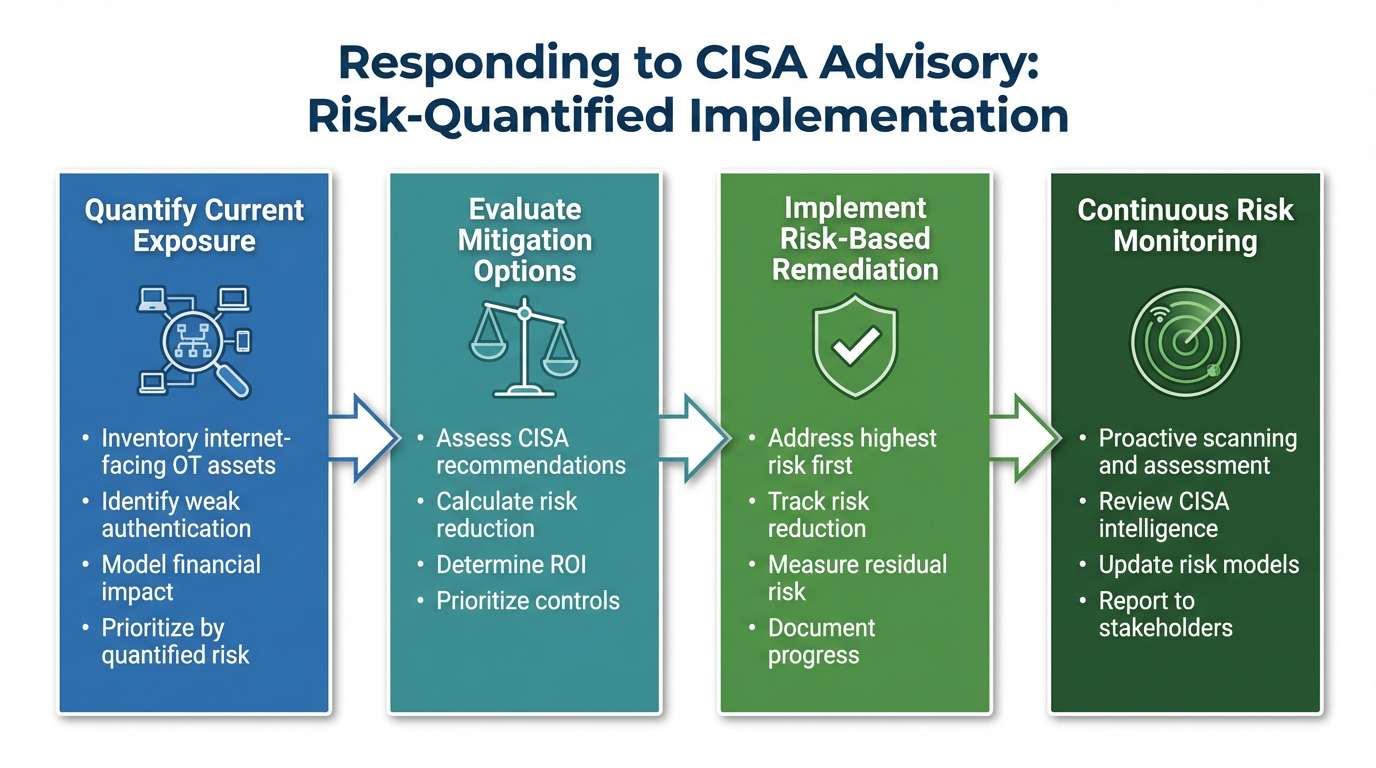
Strategic approach to implementing CISA's OT security recommendations
Practical Implementation: Responding to the CISA Advisory
Organizations looking to address the risks identified in the CISA advisory should consider a quantified approach to implementation:
Phase 1: Quantify Current Exposure
- Inventory internet-facing OT assets (as CISA recommends using attack surface management)
- Identify assets with weak authentication, default credentials, or exposed VNC services
- Model the quantified financial impact if these assets were compromised using the TTPs described in the advisory
- Prioritize based on quantified risk rather than asset count or vulnerability severity
Phase 2: Evaluate Mitigation Options
- Assess CISA's recommended mitigations (network segmentation, VPN implementation, authentication hardening) against your quantified risk exposure
- Calculate the risk reduction and ROI for each mitigation approach
- Prioritize controls that deliver maximum risk reduction per dollar invested
Phase 3: Implement Risk-Based Remediation
- Address highest quantified-risk exposures first, even if they involve "basic" vulnerabilities like weak passwords
- Track risk reduction as mitigations are deployed
- Measure residual risk to inform ongoing security investment
Phase 4: Continuous Risk Monitoring
- Monitor for new internet-exposed OT assets (shadow IT/OT)
- Track emerging threat actor TTPs and update risk models accordingly
- Regularly requantify risk as your environment and threat landscape evolve
Key Takeaways for OT Security Leaders
The CISA advisory offers several critical lessons for operational technology security:
- Basic vulnerabilities enable real impact: The most sophisticated risk models are useless if fundamental security hygiene isn't maintained. However, prioritizing which "basic" issues to address first requires understanding their quantified business risk.
- Context determines risk: A vulnerability's true risk depends on what it protects, how it's exposed, and what operations it affects. Quantified vulnerability management provides this operational context that generic severity scores cannot.
- OT security requires business language: Convincing executives to invest in OT security improvements requires translating technical vulnerabilities into quantified financial risk and demonstrating clear ROI for mitigations.
- Threat intelligence must inform prioritization: Understanding how real threat actors operate (as detailed in the CISA advisory) should directly influence which vulnerabilities receive remediation priority based on active exploitation patterns.
- Defense requires ongoing quantification: As CISA notes, pro-Russia hacktivist groups continue to evolve, share TTPs, and form new alliances. Static vulnerability assessments become outdated quickly—continuous risk quantification ensures prioritization remains aligned with current threats.
Conclusion: From Reactive Compliance to Proactive Risk Management
The CISA advisory serves as a wake-up call: critical infrastructure is being compromised through basic security weaknesses that organizations have known about for years. The question isn't whether these vulnerabilities exist—it's why they haven't been prioritized for remediation.
The answer often lies in how organizations make vulnerability management decisions. When every scanner flags hundreds of "critical" and "high" severity findings, security teams resort to compliance-driven checkbox approaches rather than risk-based prioritization.
Quantified Vulnerability Management and Cyber Risk Quantification provide the framework for moving beyond this reactive model. By translating vulnerabilities into quantified financial exposure, contextualizing risk within operational realities, and modeling specific threat scenarios like those described in the CISA advisory, organizations can make evidence-based decisions about where to invest limited security resources.
As CISA makes clear, the threats to operational technology are real, active, and growing. The organizations that will best defend themselves aren't necessarily those with the largest security budgets—they're those that can most effectively quantify risk, prioritize remediation, and demonstrate clear business value from security investments.
The hacktivist groups described in the advisory are opportunistic, targeting the easiest vulnerabilities they can find. Don't let basic security weaknesses be your organization's point of compromise. Quantify your risk, prioritize intelligently, and ensure your OT security investments deliver measurable risk reduction.